Tuesday, 18 November 2026
Picture a 40-seat training hall on Monday. By Tuesday, an operable wall has turned it into two 20-seat meeting rooms. By Thursday the wall is folded back for a town hall with three regional offices dialling in. The room changed shape three times in a week. Did the AV notice?
In many Indian enterprises we walk into, it didn't. Microphones in Room A feed loudspeakers in Room B. A laptop appears on one display out of four. Remote participants hear their own voices echoing back, and the meeting starts twenty minutes late.
Divisible rooms make smart use of expensive floor space in Mumbai, Bengaluru or Gurugram. They are also hard to get right, because you are not designing one room. You are designing every state the room can be in, and every transition between those states. In a divisible room, the wall is the most important control input in the building.
Start With the States, Not the Equipment
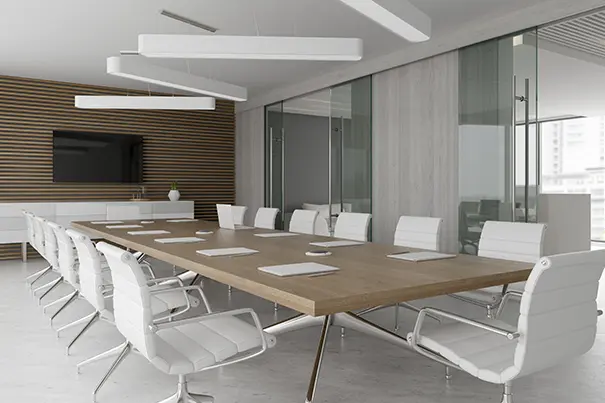
Before a single device is specified, we map every configuration. A two-way room has two states: divided (A and B separate) and combined (A+B). A three-way room in a line has four: all three separate, A+B with C separate, B+C with A separate, and all three combined. For each state, five questions need a written answer:
- Which microphones are live, and which automixer do they feed?
- Which loudspeaker zones play, and at what level?
- Which displays show which sources?
- Which codec or Teams/Zoom Room hosts the call?
- Which touch panel is in charge?
This state table is the most valuable hour of pre-sales analysis and solution design. It becomes the brief for DSP programming, control logic and commissioning. Skip it, and your users discover the edge cases.
Microphone Zoning: Every Mic Belongs to a Room, Until It Doesn't
Each microphone is assigned to a zone tied to its side of the partition. When divided, Room A's mics feed only Room A's automixer, echo canceller and far end. Room B is a separate world.
When the wall opens, those zones must merge into a single automixer, so the system picks the best microphone across the whole space. Two separate mixers will both open for a talker near the wall line, raising the noise floor.
Two details regularly catch teams out. First, the echo canceller reference: in combined mode every AEC channel must reference the same far-end signal, or remote participants hear their own voices returned from the "other" half. Second, coverage along the partition line. Ceiling arrays positioned for two divided rooms often leave a weak strip along the wall track, exactly where a presenter stands in town-hall mode. We model coverage for both states. If audio problems persist, the cause is rarely the hardware, as we explain in It's Probably Not the Microphone.

The Room-Combine Processor: The Brain That Follows the Wall
All of this lives in the DSP's room-combine logic. Q-SYS, Biamp Tesira, Symetrix and Crestron all provide room-combiner functions: effectively a matrix that knows which rooms are joined and routes microphones, programme audio, loudspeaker zones, mute and volume accordingly.
In combined mode, pressing mute on either touch panel must mute the whole space, and volume must move together. When the rooms split, each side should return to clean defaults rather than inheriting whatever state the combined session left behind.
Loudspeaker zoning follows the same logic. In a long combined room, delayed rear zones keep speech intelligible without over-driving the front rows, the same principle we apply in large conference rooms for 20 to 50 participants. Where town halls need true reinforcement, our sound reinforcement systems are tuned for the combined state and stepped down for divided use.
Independent Display Routing: Each Side Tells Its Own Story
Video is where divisible rooms fail most visibly. Divided, each room needs its own sources (laptop inputs, wireless presentation, room PC, codec) routed only to its own displays. Combined, users usually want content mirrored everywhere, or split: shared content on the front screens and the far-end gallery on the side screens.
We usually build this on a central matrix or an AV-over-IP network, so any source can reach any display without re-cabling. AV-over-IP has a particular advantage here: adding a third partition later is largely a network and configuration change, not a rack rebuild. Cameras follow the same rules, with presets for presenter and audience views in combined mode. Our AV signal flow guide explains these paths.
Codec ownership must be settled at the design stage. In combined mode, one room system typically leads the call while the other side's cameras and microphones are absorbed into it. Which room leads, and how combined bookings appear on the calendar, are design decisions. Our hybrid collaboration room engagements plan this across Teams, Zoom and Google Meet.
Automated Control: Let the Wall Be the Switch
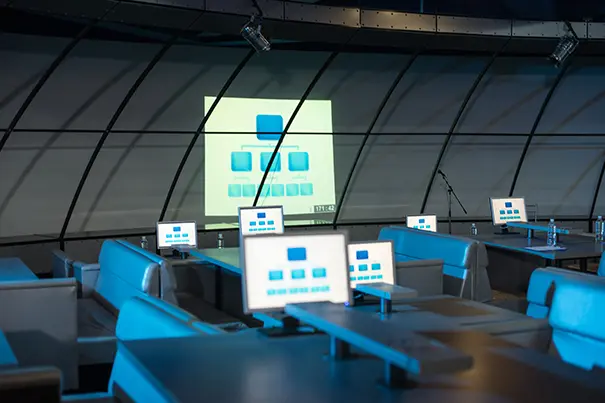
The best divisible rooms never ask users to "combine rooms". They detect it. Partition sensors, typically infrared or magnetic contacts on the wall track, tell the control processor whether the panels are open or closed. The system then recalls the matching preset: DSP combiner state, video routes, camera presets, touch panel layouts, and even lighting scenes and blinds.
We always add a protected manual override. Sensors fail and walls get half-opened for events. Every panel also shows a clear status, such as "Combined" or "Room A only", so users know what the system believes. If integrated with the room-booking system, the combined space can be represented as a single bookable resource, helping coordinate room availability and avoid scheduling conflicts.
Don't Forget the Wall Itself
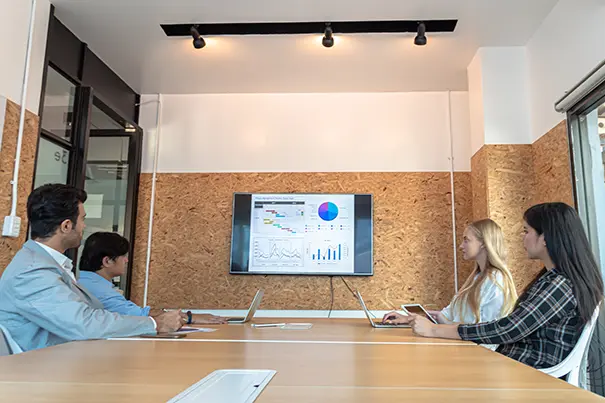
No DSP can fix a partition that leaks sound. If the operable wall performs poorly, Room A's presenter will be heard in Room B's call regardless of routing. Specify the wall's acoustic rating alongside the AV, and treat both halves properly. Our guide to acoustic treatment for conference rooms covers the principles.
Commission Every State and Every Transition
Commissioning a divisible room means testing every row of the state table, plus the transitions: combining mid-session, splitting while one side is on a call, power-cycling in combined mode. Facilities staff are then trained on override procedures through user and operational training, and managed services monitoring flags a stuck sensor before users notice.
A Room That Was Always That Size
Done well, a divisible room feels like a room that was always exactly the size you needed. That is the same principle behind our flexible AV spaces work, and the core of the CMPPL philosophy: technology should adapt to people, not the other way around.
Planning a divisible training hall, boardroom suite or town-hall space? Talk to CMPPL's design team before the partition is specified, not after.
About the Author
Sanjeev Kalhan is the Founder & CEO of Communication Media Products (India) Private Limited. An IIT Delhi engineer and IIM Calcutta MBA, he founded CMPPL in 1995 and has since led the design and integration of enterprise AV and collaboration environments across India, from boardrooms and training centres to command and control rooms. He believes technology should adapt to people, not the other way around.
Frequently Asked Questions
A divisible room is a large space that can be split into two or more smaller rooms using an operable wall or partition. Its AV system must work independently in each smaller room when divided, and as one coordinated system when the partition is opened, including audio, video, cameras, conferencing and control.
A room-combine processor, usually a function within the DSP, tracks which rooms are joined and automatically routes microphones, programme audio, loudspeaker zones, echo cancellation references and shared controls such as mute and volume to match the current room configuration.
Partition sensors, typically infrared or magnetic contacts mounted on the wall track, signal the control processor when panels open or close. The control system then recalls the matching preset. A protected manual override on the touch panel handles sensor faults or partially opened walls.
Each microphone is assigned to the room on its side of the partition. When divided, each room has its own automixer and echo canceller. When combined, all microphones join one automixer with a shared far-end reference. Coverage along the partition line should be checked for the combined state.
Yes, with careful design. In combined mode one room system typically leads the call while the other side's cameras and microphones are absorbed through the DSP and video routing. Exact behaviour depends on the platform and certified peripherals, so CMPPL validates the approach during solution design.
Both work. AV-over-IP is often preferred because any source can reach any display over the network, and adding a further partition or room later is largely a configuration change rather than new cabling and a larger matrix frame.
The most common mistakes are designing only for the divided state, running two automixers in combined mode, incorrect echo canceller references, no manual override, unclear status on touch panels, poor partition acoustics, and skipping commissioning of transitions between states.
For any inquiries or to discuss your requirements, please feel free to contact CMPPL through our website at www.cmppl.com or by email at info@cmppl.com. Our team will be happy to assist you.
Published: 18 November 2026