Monday, 09 March 2026
Indian boardrooms today operate across geographies, time zones, and formats. Strategic discussions unfold - with participants both at the table and on screen, requiring seamless alignment between physical space and digital presence.
Within this context, Microsoft Teams Room makes meetings work the way they should. Everyone can see clearly, hear clearly, and stay fully involved - without the awkward pauses or missed cues that break the rhythm of conversations. It’s that simple!
A future-ready Teams Room, therefore, extends beyond infrastructure. It demonstrates how seriously an organisation values its deliberations, which in turn would affect its customers. The way a boardroom is designed - physically and technologically - quietly influences how confidently and swiftly leaders can make decisions.

Start with the Room, the Equipment Follows
Before selecting a single device, the room must be understood.
Is this an executive decision space for about six leaders? A cross-functional strategy room for twelve? A quarterly review room hosting external stakeholders?
Room sizing extends beyond square footage: it is about studying behaviour. Who anchors the discussion? Where does conversation naturally originate? Does leadership present from a seated position or move strategically across the room? Are whiteboards central to strategic thinking, or is content primarily screen-driven?
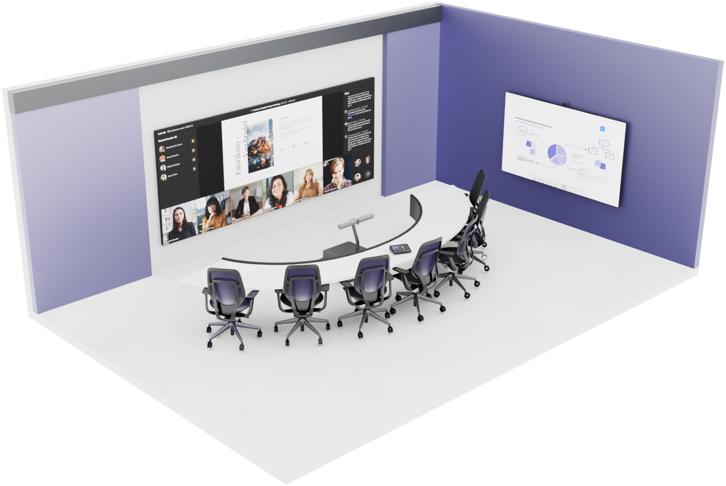
In Indian boardrooms, seating patterns often reflect organisational structure. A well-designed Teams Room anticipates this reality and ensures visual equity across the table. Camera placement and sightlines are calibrated so that every participant - regardless of position - carries equal presence in the virtual frame.
When spatial behaviour is thoughtfully understood, hardware selection becomes customized and intentional. Technology would then align with the flow of leadership, rather than simply occupying space in the room.
© Image Copyright - Microsoft
Hardware Selection and Microsoft Signature Standards
- Displays must create equality between those in the room and those joining remotely. If remote participants feel secondary, the quality of the discussion immediately drops.
- In large boardrooms, one screen is rarely enough. Leadership conversations demand simultaneous attention to data and to people. Dual displays - one for faces and the other for content - enable conversations to move forward without compromise.
- Cameras cannot be static afterthoughts. They must respond intelligently to movement and discussion. Auto-framing, Pan-Tilt-Zoom (PTZ) in large rooms, and dual camera setups ensure remote participants remain integrated into the discussion, with equal visibility and voice.
- Placement of cameras is also critical to meeting success. They should sit at natural eye level. When they are stuck awkwardly in ceiling corners, this placement distorts presence and weakens connection. Leadership dialogue depends on visual alignment as well.
Microsoft Signature-certified Teams Room devices provide predictability. Seamless integration, consistent firmware updates, and performance assurance - reduce friction. In executive environments, reliability is a governance requirement - not a technical benefit. Signature standards protect both experience and long-term lifecycle management.
The Real Backbone of Collaboration is Audio Architecture
If video builds presence, audio builds trust. In the Indian corporate settings - where multilingual discussions, overlapping dialogue, and energetic debates are common - audio clarity determines meeting success.
- Ceiling-mounted beamforming microphones or distributed microphone arrays ensure voices are captured evenly across the table. Echo cancellation, directional noise suppression, and carefully positioned speakers - prevent meeting fatigue.
- Acoustic treatment matters too. Glass-heavy and hard-surface boardrooms amplify distortions, while subtle acoustic panels or softened finishes dramatically improve voice clarity.
- Under-engineered audio is the most common design failure in hybrid spaces
Network Readiness and Security Foundations
Even the best-designed room will fail with a weak network. Dedicated VLANs for AV traffic, properly configured Quality of Service (QoS), and bandwidth planning ensure Teams traffic remains prioritized and protects continuity during critical discussions.
Security is designed into the architecture from the outset. End-to-end encryption, centrally managed firmware, and administrative controls ensure that every conversation remains protected and compliant. For sectors such as healthcare, finance, and manufacturing, this level of security supports regulatory integrity and reinforces organisational trust at the highest level of decision-making.
Cost Considerations - Investment with Intent
Future-ready designs reflect disciplined investment.
Capital allocation is directed towards the components that shape real impact. Audio intelligence, advanced camera systems, and high-resolution display environments - elevate engagement and decision quality. Future-ready design ensures that each element is selected for longevity, performance, and measurable contribution to leadership effectiveness.
Total cost of ownership remains central to this approach. When designed with foresight, the boardroom becomes an environment that strengthens authority, accelerates decisions, and sustains stakeholder engagement - over time.
The Boardroom As a Strategic Asset
Hybrid collaboration has become an integral part of modern leadership. Boardrooms today are designed to support distributed decision-making. This supports the same confidence and coherence as in-person engagement.
When executed thoughtfully:
- Technology recedes into the background
- Conversations maintain their natural flow
- Strategy moves forward with clarity
- and Leadership presence extends effortlessly across locations
CMPPL designs Microsoft Teams Room environments to act as integrated collaboration ecosystems. We ensure that spatial planning, certified technology, audio architecture, and network intelligence converge - supporting organizational intent and long-term scalability. This is an opportunity to view these spaces as strategic enablers of leadership performance.
The way boardrooms are designed today will shape how decisions are made, aligned, and executed for years to come. To explore how your boardrooms can evolve into future-ready collaboration environments, connect with our experts for a structured and value-added consultation.
ABOUT THE AUTHOR
Sanjeev Kalhan is the Founder & CEO of CMPPL, with over 30 years in AV, computing and technology leadership. He founded CMPPL in 1995 and holds a B.Tech in Electrical Engineering from IIT Delhi and an MBA from IIM Calcutta. Connect with him on LinkedIn.
For any inquiries or to discuss your requirements, please feel free to contact CMPPL through our website at www.cmppl.com or by email at info@cmppl.com. Our team will be happy to assist you.